

From Yayoi Kusama’s monumental flowers to Lee Ufan’s suspended gestures, five works at Frieze Seoul consider loneliness not merely as solitude, but as a condition shaped by distance, memory and the persistent desire to connect.
Five Works at Frieze Seoul 2026
Loneliness rarely appears in contemporary art as an empty room. More often, it inhabits the intervals between things: the distance separating two marks, the seam joining divided surfaces, the barrier interrupting an embrace, or the shadow left when a familiar form becomes displaced from its origin.
Across five works presented at Frieze Seoul 2026, loneliness emerged as both an emotional register and a spatial proposition. Although radically different in material and visual language, the selected works by Yayoi Kusama, Lee Ufan, Yohan HÀN, Tracey Emin and Jemana Murti each stage an encounter between presence and separation.
Here, loneliness is not synonymous with isolation. It is a state of heightened relation—a consciousness of the distance between the self and the world, accompanied by an enduring impulse to cross it. Bronze reaches towards the sky. Two brushstrokes address one another across an expanse of silence. Disparate skins are sutured into a shared terrain. Two figures attempt intimacy through a barrier. Cultural memory survives as a technologically fabricated shadow.
Together, the works construct an architecture of loneliness: five distinct meditations on what it means to remain separate, yet never entirely disconnected.
Yayoi Kusama
FLOWERS THAT SPEAK ALL ABOUT MY HEART GIVEN TO THE SKY, 2018
Presented by David Zwirner
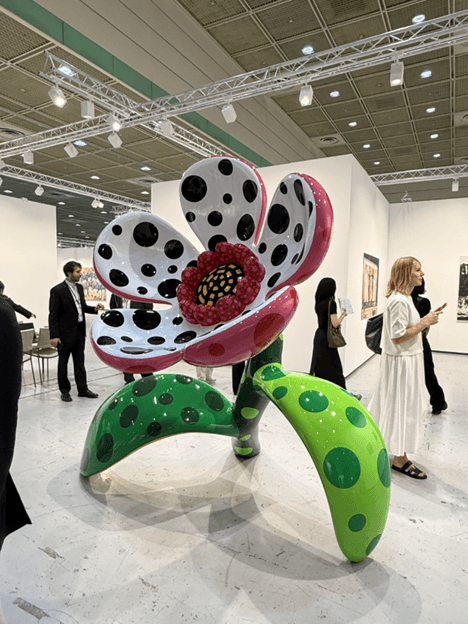
At first encounter, Yayoi Kusama’s monumental floral sculpture appears to resist loneliness entirely. Its saturated color, theatrical scale and proliferating polka dots project an unmistakable exuberance. Yet beneath this visual abundance lies a more complicated psychological condition.
Kusama has long used repetition as a means of destabilizing the boundaries of the self. The dot, endlessly multiplied, becomes both a declaration of presence and an instrument of disappearance. Individual identity dissolves into an infinite visual field—an idea the artist has described through the recurring logic of self-obliteration.
In FLOWERS THAT SPEAK ALL ABOUT MY HEART GIVEN TO THE SKY, the flower assumes an anthropomorphic presence. Enlarged far beyond its natural proportions, it no longer reads as botanical ornament. It becomes a surrogate body: animated, vulnerable and almost imploring.
The title transforms this body into an act of address. These are not simply flowers turned towards the sky; they are flowers entrusted with the task of speaking everything contained within the heart. The work externalizes an interior world that has become too expansive to remain private. Emotion is displaced into an invented species and sent upward in search of a listener.
Its material intensifies this contradiction. Cast in painted bronze, the sculpture renders permanent what is ordinarily fragile and ephemeral. The natural flower, whose beauty depends partly upon its disappearance, is denied decay. It becomes enduring but strangely solitary—a bloom removed from season, landscape and time.
Kusama’s spectacle therefore conceals a poignant estrangement. The work is crowded with pattern yet organized around a singular emotional appeal. Its joy carries the trace of longing: the desire to merge with something larger while remaining confined within the irreducible borders of the self.
Painted bronze, 228 × 232 × 186 cm.
Lee Ufan
Dialogue, 2018
Presented by Mennour
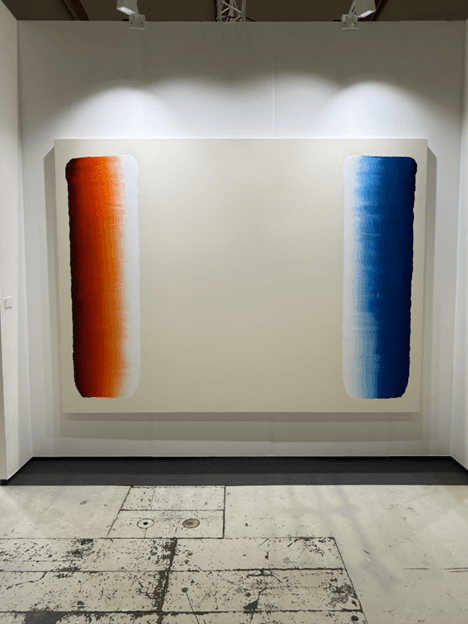
If Kusama fills space until the individual threatens to disappear, Lee Ufan allows emptiness to become almost absolute.
In Dialogue, two vertical gestures occupy a broad expanse of unpainted canvas. One is red, the other blue. Positioned apart, they neither converge nor mirror one another. Their relationship is sustained through distance.
Lee’s economy of means is never simply minimalist. Emerging from the philosophical foundations of Mono-ha, his practice is concerned with the encounter between material, gesture, space and perception. A painted mark does not function as an autonomous image; it activates everything surrounding it. The untouched canvas is not a passive background but a field of latent energy.
The title suggests exchange, yet the painting withholds any visible resolution. Red and blue remain distinct presences: warm and cool, corporeal and atmospheric, advancing and receding. The vacant space between them becomes the site where their dialogue occurs.
This is loneliness understood not as abandonment, but as an ethical acknowledgment of difference. Each gesture exists fully without absorbing the other. They communicate precisely because they remain separate.
Their softened edges also register the temporal dimension of Lee’s painting. Pigment appears concentrated before gradually dispersing, as though each mark were exhaling into the surrounding space. Presence is shown as temporary, already entering the process of disappearance.
The painting’s silence is therefore neither neutral nor serene. It carries the tension of an exchange that may never be completed. The two forms remain suspended in mutual awareness, held together by the very interval that prevents them from touching.
Dialogue proposes that intimacy does not always arise through proximity. At times, it resides in the attentive preservation of distance—in the willingness to remain present before another without demanding that separation cease to exist.
Acrylic on canvas, 218 × 291 cm.
Yohan HÀN
Weavescape, 2026
Presented by ARARIO GALLERY
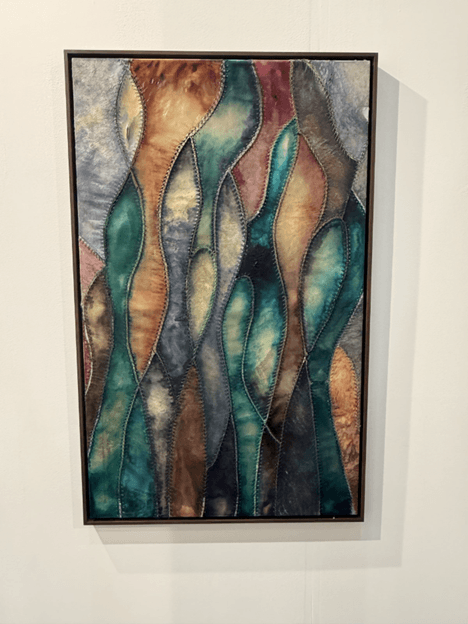
Yohan HÀN’s Weavescape resembles an abstract textile or fragmented topography. Elongated fields of green, blue, amber and burgundy unfold vertically, interrupted by exposed lines of waxed thread. Yet the work is not made from conventional fabric. Its surface is composed of drum skins.
This material distinction is fundamental. A drum skin is a membrane: a boundary made expressive through pressure. Stretched between emptiness and impact, it transforms physical contact into resonance. Even when silenced, it retains the memory and potential of sound.
In Weavescape, these resonant surfaces have been cut, painted and reassembled. The stitched seams do not disappear into the composition; they remain visibly inscribed across it. Each line acknowledges an earlier separation while performing the labor of reconnection.
The work’s title conflates weaving with landscape, suggesting a terrain constructed through interdependence rather than geographical continuity. Its irregular sections resemble territories, bodily fragments or zones of sensation. Color migrates across their surfaces but does not entirely reconcile them.
HÀN’s wider practice frequently considers the body as a threshold between material and immaterial experience. Within this framework, skin is never simply an exterior. It is the place where the self encounters what lies beyond it—a surface that receives pressure, transmits sensation and records contact.
This transforms Weavescape into a meditation on embodied loneliness. Its fragments have been brought together, yet their divisions remain legible. Connection does not restore an imagined state of wholeness; it produces a new form whose integrity depends upon the visibility of its ruptures.
The waxed thread becomes both scar and structure. It holds the work together without erasing what has been divided. In doing so, HÀN rejects seamlessness as the condition of belonging. The work suggests that intimacy may be formed through the recognition of damage, difference and discontinuity.
Its silence is particularly resonant. A material once intended to produce communal sound now exists as a static visual field. Yet the possibility of vibration persists within it, as though the surface were waiting for an encounter capable of making it speak again.
Drum skins, waxed thread, watercolor and gouache, 130.3 × 80.3 cm.
Jemana Murti
Shadows, 2026
Presented by Gajah Gallery
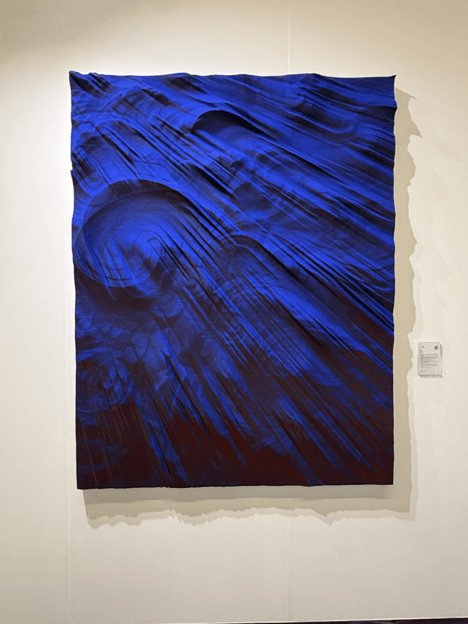
Jemana Murti’s Shadows initially appears fluid and organic. Across its electric-blue surface, ridges gather and disperse like water, pleated cloth or terrain shaped by an invisible current. Its material reality, however, belongs to an entirely different register: the work is constructed from 3D-printed ABS and acrylic.
This discrepancy between appearance and construction is central to its meaning. What seems handmade is digitally generated; what appears fluid is structurally fixed. The surface occupies an ambiguous territory between object and image, physical artifact and computational translation.
Murti’s practice brings Balinese cultural references into dialogue with digital modelling and contemporary fabrication. Tradition is not reproduced as a stable inheritance. Instead, it passes through technological systems that alter its form, scale and material presence.
Within this process, Shadows considers what remains when cultural memory is separated from its original context. A shadow is dependent upon an object, yet it is not the object itself. It preserves an outline while surrendering substance, detail and origin.
The work’s monochromatic blue deepens this sense of estrangement. Color unifies the composition while withholding the visual diversity associated with lived environments. Cultural form becomes spectral: recognisable in its rhythms and contours, but displaced into a synthetic material and technologically mediated language.
Yet Murti does not present this translation as simple loss. Digital fabrication becomes a means through which inherited forms can mutate and continue. The work occupies the tension between preservation and transformation, asking whether cultural continuity depends upon fidelity—or upon the capacity to survive alteration.
Its surface changes according to light and the viewer’s position. Recesses darken, ridges become luminous and forms momentarily appear before dissolving back into the field. The shadow is therefore never singular. It is continually produced through encounter.
In this sense, the work proposes loneliness as a condition of cultural displacement: the experience of carrying an origin that can no longer be inhabited in its original form. What remains is neither replica nor absence, but an evolving trace—estranged from its source, yet still capable of generating presence.
3D-printed ABS and acrylic, 180 × 140 cm. Presented at Booth C29.
The Distance That Connects
Despite their divergent visual languages, these five works share an investment in the threshold: the unstable territory between the self and everything beyond it.
Kusama’s flower addresses an unreachable sky. Lee’s gestures remain divided by an expanse of activated silence. HÀN’s drum skins are connected through seams that preserve the evidence of fragmentation. Emin’s figures meet across a barrier. Murti’s digitally constructed surface holds the shadow of a cultural source transformed by distance.
None treats loneliness as a purely private emotion. Instead, it becomes material, spatial and relational. It is built into the scale of a sculpture, the interval of a painting, the tension of a membrane, the resistance of a fence and the technological translation of inherited form.
The works also resist easy consolation. Their separations are not entirely overcome. Yet neither do they collapse into absolute isolation. Each contains a gesture directed outward: a flower speaks, two marks converse, fragments are stitched, bodies reach and shadows preserve the trace of what is absent.
This may be the central paradox of loneliness: it is painful precisely because the desire for connection remains alive within it.
At Frieze Seoul 2026, these five works gave that paradox an aesthetic structure. They revealed loneliness not as emptiness, but as a charged interval—a distance made visible by everything that continues to reach across it.